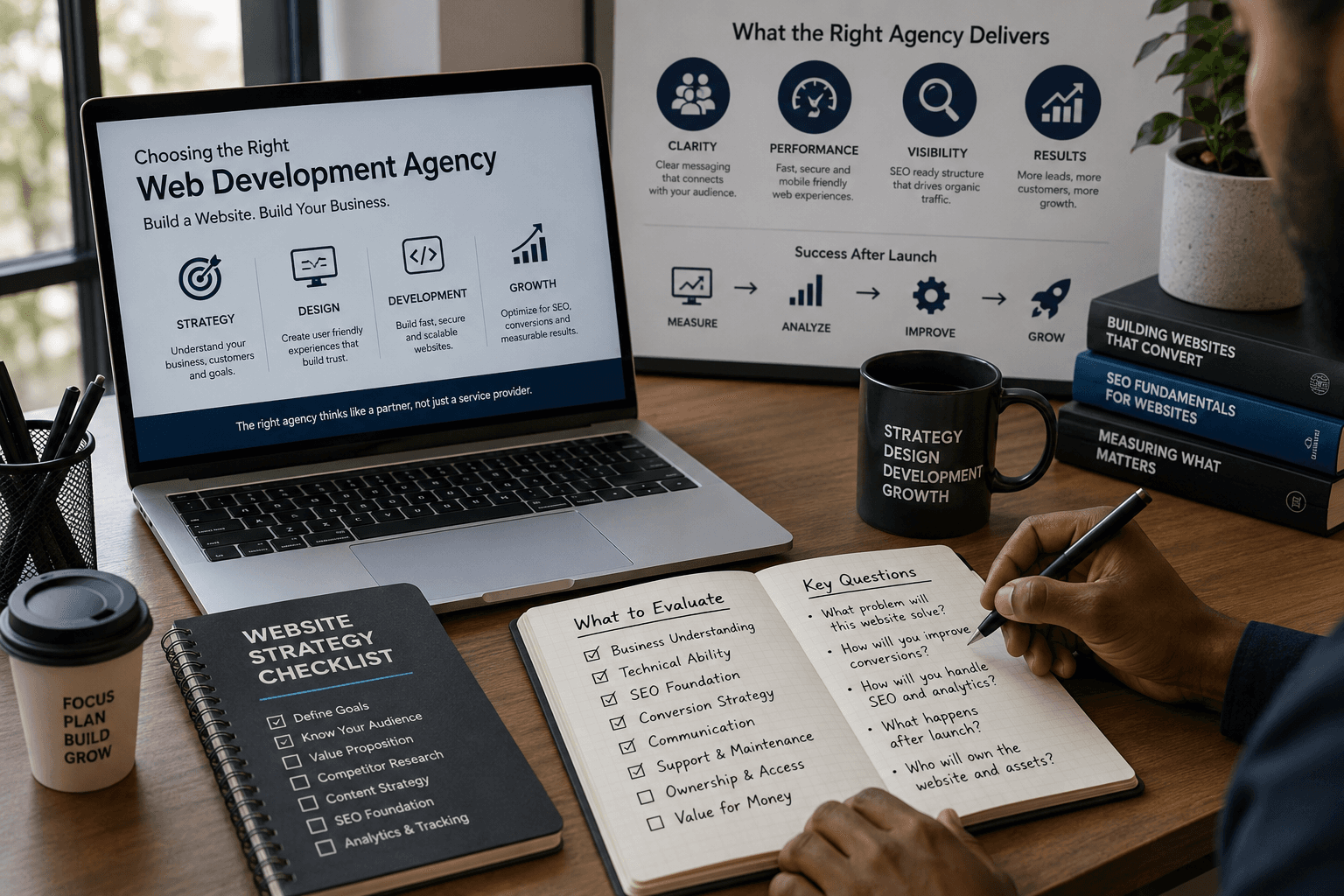
How Do I Choose the Right Web Development Agency for My Business?
Choosing a web development agency is not about picking the prettiest portfolio. This guide shows business owners how to evaluate strategy, technical ability, communication, SEO readiness, pricing, ownership, and long term support before hiring an agency.
DK
Frank Tamale
Founder & Lead Engineer
15 May 202613 minute read
Web DevelopmentWebsite StrategyBusiness WebsiteSEOAgency SelectionDigital Growth
Share
Choosing the right web development agency is not a design contest. A beautiful website that does not generate leads, explain your offer, load quickly, rank in search, or support your operations is decoration. Decoration does not pay for itself.
The right agency should understand your business model, your customers, your sales process, your technical needs, and your growth targets before writing code. If they jump straight into colors, animations, and page counts, they are treating your website like a brochure instead of a business system.
ℹ
Simple rule: do not hire a web development agency because they can build a website. Hire one because they can connect your website to business outcomes such as enquiries, bookings, purchases, customer trust, automation, and measurable growth.
Why This Decision Matters
Your website is often the first serious proof that your business is real. A customer may see your ad, hear about you from a friend, find you through Google, or check your profile after a referral. In many cases, the website is where trust is either confirmed or lost.
A poor agency choice creates more than a bad design. It can leave you with slow pages, weak messaging, poor mobile experience, missing analytics, broken forms, poor SEO foundations, unclear ownership, and a site that becomes expensive to maintain. The visible damage is the website. The hidden damage is lost revenue and lost time.
What the Right Agency should improve?
A serious agency should improve more than how the website looks.
Trust
Clear
Visitors understand who you help and why they should believe you.
Conversion
Measured
The site pushes visitors toward calls, forms, bookings, or purchases.
Visibility
Search Ready
Pages are structured so search engines can understand them.
Operations
Connected
Forms, CRM, analytics, email, and automation work together.
Start With the Business Problem
Before you compare agencies, define the problem the website must solve. Most businesses skip this step, then wonder why the final site feels attractive but useless. A website for a law firm, real estate company, clinic, SaaS product, restaurant, logistics company, school, or digital agency should not be planned the same way.
A good agency will ask uncomfortable questions before proposing a solution. Who is the customer? What action should they take? What objections stop them from taking action? Where does traffic come from? What happens after a form submission? Who follows up? How will success be measured after launch?
Lead generation: the site must turn visitors into enquiries, calls, quote requests, or booked consultations.
Online sales: the site must handle products, payments, inventory logic, order flow, and customer communication.
Authority building: the site must explain expertise, show proof, answer objections, and support content marketing.
Operational efficiency: the site must connect forms, dashboards, CRM tools, email, reports, or internal workflows.
Recruitment: the site must communicate culture, roles, benefits, application flow, and employer credibility.
⚠
Avoid this mistake: asking for a website before defining what the website must produce. That is how businesses buy pages instead of outcomes.
The Agency Selection Scorecard
Use a scorecard before you hire. This removes emotion from the decision. The agency with the nicest homepage is not always the agency that can build the strongest system for your business.
Web Development Agency Evaluation Scorecard
Score each agency from 1 to 10 across the areas that affect business value.
Ideal minimum score
View chart data
category
Ideal minimum score
Business understanding
9
Technical ability
8
SEO foundation
8
Conversion strategy
9
Communication
8
Support plan
7
A weak score in business understanding or conversion strategy is more dangerous than a weak score in visual style. Source: VeilCode agency evaluation model
The strongest agencies usually combine strategy, design, development, SEO fundamentals, analytics, and post launch support. The weak ones sell a website as a one time design task. That approach may be cheaper at the start, but it usually becomes expensive when the business needs changes, speed improvements, content updates, tracking, landing pages, or integrations.
1Business understanding: can they explain how your website will support revenue, trust, sales, or operations?
2Technical ability: can they build a fast, secure, scalable, and maintainable website?
3SEO foundation: do they structure pages, metadata, headings, internal links, schema, performance, and content properly?
4Communication: do they explain decisions clearly, document scope, and manage feedback without confusion?
5Support plan: do they offer maintenance, monitoring, updates, analytics review, and improvement after launch?
Why Portfolio Alone Is Not Enough
A portfolio shows what an agency can make visible. It does not always show whether the site loads fast, ranks in search, converts visitors, integrates with business tools, or remains easy to manage after launch.
When reviewing portfolio work, do not only ask whether the designs look good. Ask what problem each website solved. Ask what changed after launch. Ask whether the agency handled strategy, copy, development, SEO, analytics, content structure, hosting, security, and ongoing improvements
Check mobile experience: most customers will not forgive a poor mobile layout.
Check clarity: the homepage should make the offer obvious within a few seconds.
Check calls to action: visitors should know exactly what to do next.
Check proof: testimonials, case studies, results, project examples, certifications, or clear process details should support trust.
Check content structure: service pages should answer real buying questions, not just repeat slogans.
ℹ
Better question: do not ask, can you build something like this? Ask, why was it built this way, what outcome did it support, and what would you improve if you rebuilt it today?
Questions to Ask Before Hiring
A serious web development agency should welcome detailed questions. Weak agencies hide behind vague answers because their process is not mature. Your questions should test thinking, execution, ownership, and support.
1What will you need to understand before designing the website? This reveals whether they start with strategy or guesswork.
2How will you structure the site for SEO? This reveals whether SEO is part of planning or an afterthought.
3How will you improve conversion? This reveals whether they understand calls to action, proof, user intent, and buyer psychology.
4What technology will you use and why? This reveals whether they choose tools based on the business case or personal habit.
5Who owns the website after launch? This prevents future hostage problems around domains, hosting, code, content, and admin access.
6What happens after launch? This reveals whether they provide support, monitoring, maintenance, and improvement.
7How will performance be measured? This reveals whether analytics, events, forms, traffic, and conversion tracking will be implemented.
8How do you handle revisions and scope changes? This prevents conflict when new requirements appear.
What Your Evaluation Should Prioritize
A practical weighting model for choosing a business focused web development agency.
Business strategy25
Technical execution20
SEO foundation15
Conversion thinking20
Communication10
Support10
View chart data
area
Decision weight
Business strategy
25
Technical execution
20
SEO foundation
15
Conversion thinking
20
Communication
10
Support
10
Visual style matters, but it should not outweigh strategy, conversion, technical quality, and long term usability. Source: VeilCode website buying framework
Red Flags That Should Stop the Deal
Some agencies will sound confident because confidence is easy to fake. Process is harder to fake. Documentation is harder to fake. Strategic questioning is harder to fake. Clear ownership terms are harder to fake.
They promise rankings without discussing content, competition, technical SEO, or time. That is not strategy. That is bait.
They ask for your brand colors before asking about your customers. This means they are starting at the surface.
They cannot explain their development process. You should know how discovery, design, development, review, testing, launch, and support will work.
They avoid ownership questions. You should control your domain, hosting access, admin access, code agreement, and content rights.
They have no testing process. Forms, responsiveness, browser behavior, speed, analytics, metadata, and redirects need testing.
They treat SEO as a plugin. SEO is not a switch. It requires structure, content, performance, metadata, internal linking, and technical discipline.
They cannot explain how the website will generate business value. A website without a business case is just an expense.
⚠
Hard truth: if an agency cannot explain how your website will help the business make money, save time, build trust, or capture demand, they are selling production, not value.
How to Think About Pricing and Scope
The cheapest proposal is often the most expensive one after revisions, missing features, poor performance, weak SEO, unclear support, and rebuild costs. Price only makes sense when scope is clear.
A useful proposal should explain deliverables, page structure, design process, development stack, content responsibility, SEO setup, analytics setup, integrations, hosting assumptions, timeline, revision limits, maintenance, and ownership. If these are missing, the price is not comparable to another agency proposal.
Small business brochure website: suitable when the goal is credibility, service explanation, and lead capture.
Conversion focused service website: suitable when the goal is enquiries, local SEO, landing pages, testimonials, and measurable calls to action.
Ecommerce website: suitable when products, payments, inventory, delivery flow, and customer communication matter.
Custom web application: suitable when the business needs dashboards, user accounts, workflows, databases, permissions, or automation.
Growth website: suitable when the website needs content strategy, analytics, SEO, landing pages, tracking, and continuous improvement.
How Website Value Usually Compounds After Launch by channel
The first launch creates the foundation. Value increases when the site is measured, improved, and connected to marketing activity.
Business value index
View chart data
period
Business value index
Launch
30
Month 1
42
Month 2
55
Month 3
68
Month 6
82
A website becomes more valuable when performance data, SEO content, conversion improvements, and customer feedback are used after launch. Source: VeilCode website growth planning model
Final Decision Framework
The right web development agency should make you feel clearer, not more confused. After speaking with them, you should understand what they will build, why it matters, how it will support the business, what it will cost, what you will own, and what happens after launch.
VeilCode Newsletter
Stay Sharp on What Matters
Engineering deep-dives, design thinking, and practical AI — written for builders who care about craft. No fluff. No spray.
No spam. Unsubscribe any time.
Continue Reading
Related Articles
Engineering
DK
Building Fast Web Apps for Low-Bandwidth Markets
Performance optimisation isn't a nice-to-have when your users are on 3G in Kampala or Nairobi. Here's the exact stack and techniques we use to build sub-2s load times across East Africa.